From the seller:
This evening ensemble is comprised of a jacket, bodice, over-skirt and one single remaining detachable sleeve (shown further down in the images.) This gown hails from the early part of the 19th century, most likely the end of the 1820s or the early 1830s, the cusp of the Romantic and Sentimentalist Eras. It's made of a gorgeous cobalt blue silk faille taffeta, of which many close-up images are provided.
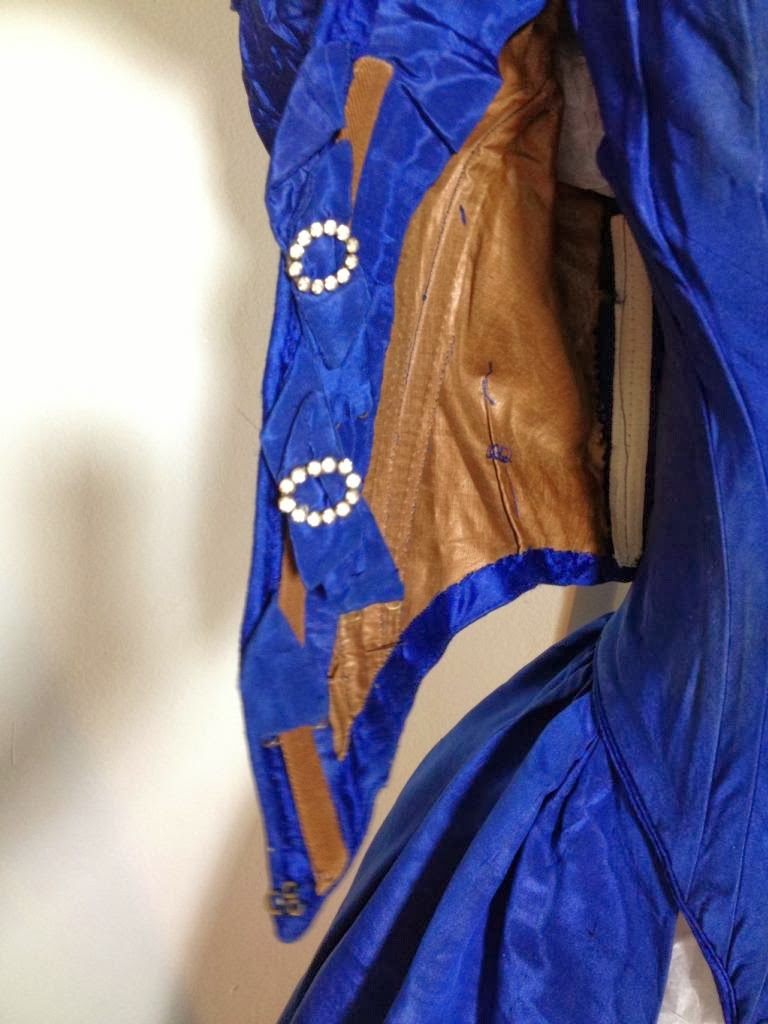
At the time this gown was tailored, there's little doubt this was the finest quality fabric available. It is lighter and finer than what we now consider taffeta due to the quality of the weave and fiber- a bit more fluid and the color and quality of the silk faille are simply unparalleled. There is a subtle 'changeant' quality to the fabric, showing most as cobalt blue, but with mild indigo to purple sheens in some lights. The period oval paste diamond buckles on two of the jacket's front closures hint that this could have been worn with other similar luxe adornments.
The drop-shouldered boned bodice is self-piped in the same fabric and has a wide neckline forming a very shoal v at center front. A double line of piping runs across the top or neckline and for sleeve detail, at the bodice' bottom edge as well as the front edges of the jacket. The interior is padded at the bust in a lighter cream colored fabric.
The jacket also has a series of stays for shape and features puffed ' Demi - Gigot ' sleeves which would likely have been filled with down 'bolsters' to keep them ballooned and fluffy. The jacket closes in the front with three self silk tabs, two of which feature oval paste 'diamond' buckles set in brass mounts and has two brass hooks and eyes hidden closures per tab. Similar brass or copper hook and eye closures are found in the bodice, in line down the rear inside placket for closure, which are then covered by the blue silk placket which would be laced through the eyelets.
The gathered overskirt is sewn to a black silk grosgrain waistband and has a wonderful hang and 2" deep hem as well as 2" turnover at both front edges. The single remaining detachable sleeve is self-piped at the opening and lined there with white silk. Rather than display the gown's overskirt over a non-period-appropriate cotton petticoat, we chose to photograph it over nothing but white tissue, which is what can be seen showing down the front from center of the bodice to the floor. This can be called an open gown or was even sometimes called a night gown, as in worn to events at night. Now, evening gown is most appropriate.
The single remaining detachable sleeve is shown on both sides and with peeks at the lining in the close-up shots of the gown as we had no other way to display it. The reverse of the overskirt was pressed through a velvety soft white linen tablecloth we retain for that use, but neither the jacket, bodice nor sleeve were pressed or steamed for the purpose of display and as such are shamefully wrinkled, but will come up beautifully.
The interior construction of both the jacket and bodice is made of a brown glazed cotton or linen and it appears extra stays have been sewn into the interior of the jacket as well as the addition of a front tab to the waistband of the over-skirt. Both of these additions appear to be the only alterations- the additional stays covered in a white cotton and the waist tab is of white panne silk. The original stays in the bodice are inline as they should be, though the jacket's front stays especially that of the right side are somewhat warped, but all are intact with no known separations.
There are light blue areas (evidencing moisture to the silk coming through when worn) at the interior of the arm-hole on the glazed cotton lining of the jacket that show only very faintly, if at all on the exterior silk faille, as shown in the images. We doubt any of this outfit has otherwise ever seen water. That this gown must have been properly cleaned without water is further evidenced by the fact that water would have destroyed the fabric's pronounced moire pattern.
There remains a quarter-inch long piece of double-twist cobalt silk cord coming from in the top right hole of the line of corset eyelets in the rear of the bodice-- evidence of the original lacing. For display, we used two doubled lengths of light brown tapestry wool, sewn through the eyelets with tapestry needles. The bodice was smaller in the torso than our size 0-2 mannequin by about 2 inches, so the images of the bodice's rear show that gap. Both the jacket' and bodice' bust were larger than our that of our mannequin, so some gentle stuffing with tissue paper ensued.
We stuffed the sleeves, bust and overskirt of the gown for display on our size 0-2 mannequin, over stuffing the bust of both the jacket and bodice separately- because they were larger than the form as previously mentioned. From this we gamble that the gown was originally fitted for a lady with 22 inch or smaller waist and perhaps a 36 to 38 inch bust.
Mannequin measurements, as taken around the torso are as follows:
-31 and a half inches under the arms
-33 inches at bust
-24 and a half inches at waist
-34 inches at hip
-53 to 54 inches is the distance from the shoulder to the floor as the gown is displayed ranges from:
-40 to 42 inches is the distance waist to floor (though the overskirt would be worn a couple of in inches higher):
Garments measured flat unless otherwise noted:
jacket
-17 and a half inches across directly under the arms
-14 and a half inches across at the waist
-14 and a half inches at rear center top to bottom
-21 inches from shoulder seam at front to front center point
-5 inches across at sleeve opening
bodice
-14 and a half inches across directly under the arms
-12 and a half inches across at the waist
-15 and a half inches from front top to bottom center point
overskirt
-23 inch total width of black silk waistband
-6 inch additional white silk tab sewn to waistband front
-88 inch length, measured at right left and & center from the bottom edge of waistband to hem
-105 inch width at bottom
single detachable sleeve
-17 inches long, centered
-6 and a half at unpiped end
-8 inches at opening of piped end
What has preserved this gown has been constant climate control and a total lack of exposure to light. The black silk grosgrain waistband to which the gathered overskirt is sewn bears replacement or at the least, backing with something sturdier, as it is the driest part of the whole outfit, and shows several small mends, although it is a non-showing part of the gown. The other fabrics are in fantastic shape considering they have not been removed from storage of the past 40 years.
These garments should >never< be wet cleaned or subjected to water and should only be ironed or steamed with extreme care. We have done nothing but lightly press the overskirt, display the gown for photography and return it to tissue paper and darkness. No cleaning or repair of any kind has been undertaken other than the use of the tapestry wool to lace the bodice. This gown is an antique and is not perfect, showing loose threads here and there in seams and the minor anomalies created by wear, but again, is in breathtaking condition. The fabrics and seams in the bodice and jacket and overskirt are plenty sturdy for our careful lacing and display, but this nearly two century old dress would probably not survive being worn by a live model, which we mention for the sake of preservation alone. This ensemble is incredibly simple in line, yet very high style and would more than suffice for a ball at the height of the season or presentation at court. An overview of this period of fashion is available at : http://www.cfa.ilstu.edu/lmlowel/the334/romantic/romanticreview.htm Please review all text and photos carefully, the images are presented as a part of the description in attempt to fully detail this garment. A total of sixty large images, many with commentary, so you may understand what each image is pointing out, can be seen as a Photobucket gallery at this link and should be viewed and read in their entirety by anyone interested, prior to bidding.
From Me:
So...apparently the seller missed things like the sewing machine stitching and that waistband and the boning structure and the way the way the seams are finished and everything else that points to this being 1890's.
Oh, and here's a fashion plate from 1895:
Notice the dress of the lady trying to leave the scene? Yeah.
Anyway, the shoulders are interesting but this ain't from the 1820's or 1830's. Sewing machines weren't invented yet. Probably a fancy dress trying to look 17th century.